
AI in the Middle East has moved from pilot decks and press releases into production systems that serve millions of residents, tourists and businesses. If you were building here five years ago, the conversation was mostly aspirational: national strategies, sovereign ambitions and a handful of proof-of-concept chatbots. Today the picture is materially different. Government services run on machine-learning pipelines, sovereign compute is being stood up at serious scale, and the region has become a genuine buyer and, increasingly, a builder of foundation models. For engineers, data scientists and technical leaders, understanding this shift is no longer optional cultural context; it is a live factor in where you deploy, how you handle data, and which problems are worth solving.
This article is written for practitioners, not policymakers. Rather than rehearse the headline strategies, it looks at what the rise of AI in Dubai and the wider Gulf actually means when you sit down to architect a system, hire a team, or pitch a product. We will cover the infrastructure and data-residency realities, the shape of the talent market, the sectors where adoption is genuinely deep, the Arabic-language and multilingual challenges you cannot ignore, and the practical trade-offs of building in a region that is capital-rich, fast-moving and still maturing in some engineering fundamentals. The goal is to give you an accurate mental model you can act on.
Why the Middle East became an AI growth market
Three structural forces explain the acceleration, and it helps to separate them because they pull on different parts of your plan. The first is capital: sovereign wealth and state-backed funds have made long-horizon bets on compute, data centres and equity stakes across the AI stack, which means infrastructure that would take a decade to fund elsewhere gets built in eighteen months. The second is political will concentrated in a small number of decision-makers, which compresses the distance between a national strategy and a deployed system. When a ministry decides to adopt an approach, procurement and rollout can happen at a pace that surprises teams used to slower markets.
The third force is demographics and economics. The Gulf runs young, highly connected populations with near-universal smartphone penetration and a strong appetite for digital-first services. Governments are actively diversifying away from hydrocarbons, and technology is the headline vehicle for that. For a builder, this combination is unusual: you have a customer base that adopts quickly, a state that wants to be a reference customer, and funding that is patient about returns but impatient about visible progress.
The honest caveat is that momentum is uneven. Flagship projects are world-class, but the long tail of small and medium enterprises is still early in AI adoption across the Gulf, often stuck at spreadsheet-and-dashboard maturity. That gap is itself an opportunity: much of the near-term value is not frontier research but competent application of well-understood techniques to businesses that have never had them.
AI in Dubai: the region's commercial front door
Dubai occupies a specific role in the MENA AI ecosystem: it is the commercial and go-to-market hub, even when the heaviest compute or research sits elsewhere in the region. If you are launching a product, opening a regional entity, or hiring your first local team, Dubai is usually where you start because of its free-zone structures, dense concentration of enterprises, and connectivity to South Asia, Africa and Europe within a few hours' flight.
Practically, this shapes how AI in Dubai gets consumed. There is strong demand for applied systems in government services, real estate, logistics, hospitality, retail and financial services. Buyers here tend to want outcomes and integrations rather than research novelty, so a working agent that handles multilingual customer queries or a forecasting model that reduces inventory waste lands better than a benchmark score. The buying cycle can be fast once a champion is convinced, but expect proof-of-value pilots and a preference for vendors who show up in person.
This ecosystem density is also why the region has become a fixture on the global event calendar; practitioners working on these problems can meet peers, vendors and investors and go deeper at World AI Technology Expo Dubai (07-09 April 2027, Millennium Plaza Downtown Hotel, Dubai). Face-to-face relationship-building still carries disproportionate weight in Gulf business culture, and a single well-run meeting often moves things further than months of remote outreach.
Infrastructure, sovereign compute and data residency
The infrastructure story is the most consequential change for architects. The region is building substantial data-centre capacity and pursuing sovereign compute so that sensitive workloads and increasingly model training can happen in-region rather than routing to distant cloud regions. For you, this means local availability zones from major cloud platforms are now realistic anchors for latency-sensitive and residency-constrained systems, rather than a compromise you tolerate.
Data residency deserves specific attention in your design. Several jurisdictions in the region have data-protection regimes and sectoral rules that expect personal or government data to remain in-country, and free zones sometimes run their own frameworks distinct from the wider federal picture. Treat this as an architectural constraint from day one: decide early where training data, embeddings, vector databases and inference logs physically live, and confirm that your managed services and third-party APIs honour that boundary. Retrofitting residency after you have shipped is painful and sometimes forces a re-platform. This is a compliance-shaped engineering decision, and you should confirm the current specifics with qualified local advisers rather than assuming.
There is a practical trade-off between using globally hosted foundation-model APIs and keeping inference local. Hosted APIs give you the strongest models with zero operational burden but can conflict with residency and cross-border-transfer expectations. Self-hosting open-weight models in-region gives you control and residency at the cost of running your own serving, scaling and evaluation stack. A common pragmatic pattern is a tiered approach: keep regulated or sensitive workloads on in-region open-weight models, and route non-sensitive tasks to hosted frontier models, with a routing layer that enforces the boundary.
Past Speakers
Previous editions of World AI Technology Expo Dubai have brought together senior AI practitioners and leaders. Speakers below are shown for reference from previous editions; the 2027 line-up will be announced ahead of the event.

Nitin Akarte

Akshay Singh Dalal

James Hunter

Abhinav Sharma
The Arabic-language and multilingual reality
If your product touches end users in the region, language is not a localisation afterthought; it is core engineering. Arabic is diglossic: Modern Standard Arabic is the written formal register, while people actually speak in national and regional dialects that differ substantially in vocabulary and grammar. On top of that, Gulf users routinely code-switch between Arabic and English within a single message, and often type Arabic in Latin characters. A model or pipeline that performs well on clean Modern Standard Arabic can degrade sharply on real user input.
General-purpose large language models have improved markedly at Arabic, and region-focused models trained with heavier Arabic corpora are now viable options. Still, do not trust vendor claims; build a small but representative evaluation set from your actual users, covering dialects, code-switching and script variation, and measure before you commit. Retrieval-augmented systems add their own wrinkle: embedding models vary widely in Arabic quality, tokenisation can be inefficient for Arabic script, and right-to-left rendering plus mixed-direction text will surface UI bugs you never see in English-only products.
The practical checklist is short but non-negotiable: evaluate embeddings and generation separately on dialectal and mixed-script inputs; budget for higher token counts and therefore cost and latency on Arabic; test right-to-left and bidirectional rendering across every surface; and keep a human-in-the-loop review path for high-stakes outputs until your evaluation numbers earn your trust.
Sectors where adoption is genuinely deep
It is worth being concrete about where the value is landing, because it guides where a builder should aim. Government and public services are the clearest: document processing, multilingual citizen-service agents, permit and licensing automation, and predictive maintenance of public infrastructure. These are unglamorous but high-volume problems where even modest accuracy gains translate into large operational savings, and the state is a willing early adopter.
Financial services and payments are a second deep pool, with fraud detection, credit and risk modelling, and increasingly agentic customer support. Energy and utilities apply forecasting and optimisation at scale, given the region's industrial base. Logistics, ports and aviation lean on demand forecasting, routing and computer vision. Real estate and retail use recommendation, pricing and conversational commerce. Healthcare and education are expanding quickly, though these carry the heaviest sensitivity and residency constraints, so approach them with extra care and appropriate expert guidance.
The pattern across all of these is that applied, well-scoped systems outperform ambitious platform plays. The teams shipping value are not, for the most part, training frontier models; they are wiring reliable retrieval, sensible evaluation and clean integrations into existing enterprise and government systems. If you are deciding what to build, a narrow high-frequency workflow inside one of these sectors is a far safer bet than a horizontal product.
The talent market and how teams actually staff up
The talent picture is a genuine constraint and shapes hiring strategy. The region has invested heavily in AI education and is producing strong graduates, but the pool of engineers who have taken real systems to production at scale is still thin relative to demand. The result is a highly international, mobile workforce: teams are typically assembled from local talent plus experienced hires relocating from South Asia, Europe and beyond, drawn by favourable tax treatment and fast-moving projects.
For a practical staffing model, most successful regional teams blend a small senior core that owns architecture and evaluation with a larger group handling integration, data work and delivery. Because deep MLOps and evaluation experience is scarce locally, that senior core is often the hardest and most important hire, and getting it wrong shows up later as brittle pipelines and unmeasured model quality. Relocation is a real lever here; the lifestyle and compensation package makes the region competitive for senior international candidates in a way that surprises people who have not looked recently.
One organisational trade-off to watch: the same speed that makes the region attractive can produce projects that are launched faster than they are engineered. Guard against this by insisting on evaluation harnesses, monitoring and rollback plans as non-negotiable parts of any deployment, even when a stakeholder wants a demo next week. The teams that endure are the ones that pair regional pace with genuine engineering discipline.
A practical playbook for building here
Pulling the threads together, here is how a technically serious team should approach entering the market. Start by fixing your data-residency and jurisdiction decisions before you write architecture, because they cascade into cloud region, model hosting and vendor choice. Then pick a narrow, high-frequency problem in a sector with real budget rather than a broad platform. Build a representative evaluation set in your users' actual language mix early, and treat it as the source of truth for every model or vendor decision.
On the build itself, favour proven components over novelty: managed vector databases, standard experiment-tracking tools, an agent framework only where genuine multi-step reasoning is needed rather than by default, and a clear routing layer that keeps sensitive workloads in-region. Instrument everything from day one, monitoring not just uptime but output quality and drift, because Arabic and dialectal inputs drift in ways English-centric monitoring will miss. Keep humans in the loop for high-stakes outputs until the numbers justify removing them.
Finally, invest in presence and relationships. The Gulf rewards teams that show up, run in-person pilots, and build trust with a named champion inside the buyer. Combine that commercial patience with a willingness to move fast on delivery once a pilot succeeds. The organisations winning in the MENA AI ecosystem are those that respect both the region's speed and its emphasis on relationships, while never letting either erode their engineering fundamentals.
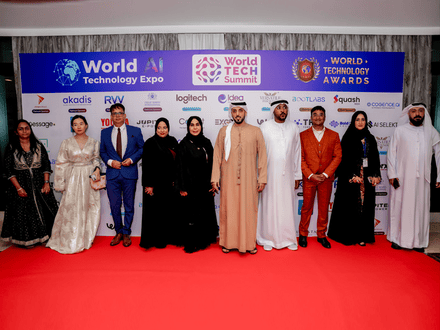
Inside the event
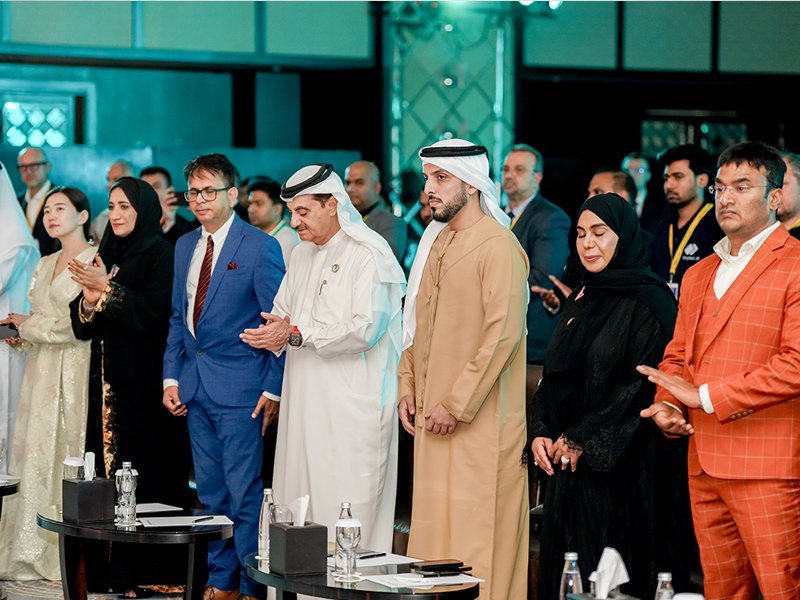
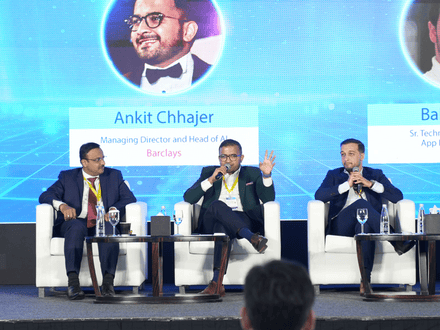
A glimpse of the atmosphere from previous editions — keynotes, the exhibition floor and the networking that defines World AI Technology Expo Dubai.


Key takeaways
- AI in the Middle East has moved from pilots to production, driven by patient capital, concentrated political will and young, digital-first populations.
- Data residency is an architectural decision, not an afterthought: fix jurisdiction, model hosting and vector-store location before you build, and confirm specifics with local experts.
- Arabic is core engineering, not localisation: evaluate dialects, code-switching and mixed scripts on your own representative test set before trusting any model or embedding.
- The deepest value is in applied, narrowly scoped systems for government, finance, energy and logistics, not frontier model training.
- Senior MLOps and evaluation talent is the scarce, decisive hire; relocation packages make the region competitive for experienced international engineers.
- Dubai is the commercial front door: in-person pilots, a named champion and relationship-building move deals further than remote outreach.
Frequently asked questions
Yes, for teams that build applied, well-scoped systems rather than chasing frontier research. The region combines patient capital, fast government-led adoption and a young digital-first population, which makes it a strong buyer and increasingly a builder. The main constraints are data-residency rules and a shortage of senior production-grade engineering talent, both of which you should plan for early.
Several Gulf jurisdictions expect personal and government data to remain in-country, and individual free zones sometimes run their own frameworks distinct from federal rules. Treat residency as a design constraint from day one, deciding where training data, embeddings, vector databases and inference logs physically live. The specifics change and vary by sector, so confirm current requirements with qualified local advisers rather than assuming.
Not necessarily, but you must evaluate for real Arabic use before deciding. Users mix Modern Standard Arabic, spoken dialects, English code-switching and Latin-script Arabic, and model quality varies sharply across these. Build a representative evaluation set from your actual users and measure both generation and embedding quality rather than trusting vendor benchmarks.
Government and public services lead, with document processing, multilingual citizen agents and infrastructure maintenance. Financial services, energy, logistics, aviation and retail follow closely with forecasting, fraud detection, optimisation and conversational commerce. Healthcare and education are growing fast but carry the heaviest sensitivity and residency constraints.
Start in Dubai for its free-zone structures, enterprise density and connectivity, then win through in-person pilots and a named internal champion. Buyers value outcomes and integrations over benchmark scores, and relationships carry disproportionate weight. Pair that commercial patience with fast, disciplined delivery once a pilot is approved.