
To stay current in AI is no longer a background task you fit around real work; for most engineers and technical leaders it has become part of the job itself. The half-life of a specific technique now feels shorter than a typical performance cycle. A prompting pattern that was best practice last quarter gets absorbed into the model's default behaviour by the next release, an architecture you spent a month integrating gets deprecated, and a benchmark everyone quoted becomes irrelevant once models saturate it. The uncomfortable truth is that the pace is not slowing down, and no single reading list will keep you ahead of it.
What actually works is not consuming more content but building a durable system for continuous learning in AI that filters aggressively, tests ideas against your own problems, and compounds over time. The professionals who stay current are rarely the ones who read every paper. They are the ones who have decided what to ignore, who learn by building small things, and who treat their attention as the scarce resource it is. This article lays out a concrete approach: how to structure your inputs, how to keep up with AI research without burning out, how to convert reading into skill, and how to know when a shiny new tool is worth your time. The goal is a repeatable habit you can sustain for years, not a heroic sprint you abandon in three weeks.
Separate the durable from the disposable
The single most useful mental move is to sort everything you encounter into two buckets: durable fundamentals and disposable specifics. Fundamentals are the concepts that survive model releases. Attention and the transformer's core mechanics, how tokenisation shapes behaviour, the bias-variance intuition behind evaluation, the economics of latency and cost, retrieval and grounding, the failure modes of probabilistic systems. These change slowly, and understanding them deeply means you can reason about a new release in an afternoon rather than starting from scratch.
Disposable specifics are the exact flags, the current context-window numbers, the name of this month's favoured library, the precise prompt that unlocks a capability. These matter operationally but rot quickly, so it is a mistake to invest heavy memorisation there. Learn them just-in-time, when a project needs them, and let documentation be your memory.
In practice this changes how you read. When a new technique appears, ask what fundamental it exploits. A clever agent pattern is usually an old idea about planning or state management dressed in new terminology. Once you see the underlying principle, you can evaluate whether it is genuinely novel or simply repackaged, and you inoculate yourself against hype that recycles the same handful of insights every few months under fresh names.
Build a tiered information diet
Treat your inputs like a funnel with three tiers. The top tier is broad, low-effort awareness: a small number of curated newsletters or aggregators that surface AI news and trends so you hear about major shifts within a day or two. You skim these in minutes and let ninety per cent pass. Their only job is to make sure nothing important escapes your notice entirely.
The middle tier is selective depth. When something clears the awareness filter and looks relevant to your work, you go deeper: read the primary source rather than the commentary, watch a talk from the people who built the thing, or read the actual documentation. This is where most people go wrong, either living entirely in the shallow tier and mistaking headlines for understanding, or trying to read everything deeply and drowning.
The bottom tier is deliberate practice, covered in the next section. The key discipline is ratio. If you spend all your time in tier one, you will sound current in meetings but be unable to ship anything. A healthy split for a working engineer is roughly fifteen minutes a day on awareness, a couple of focused hours a week on depth, and the majority of your learning budget on actually building. Write those time boxes down, because without them the shallow tier expands to fill everything.
Learn by building small, disposable projects
Reading about a capability and having used it are different kinds of knowledge, and only the second one holds up under questioning. The most reliable way to internalise something new is to build a small, throwaway project with it over a weekend or an afternoon. Wire a foundation model into a tiny tool that solves a real annoyance in your own workflow. Stand up a vector database and index your own notes to feel where retrieval helps and where it produces confident nonsense. Give an agent framework a task with a real tool and watch exactly how and where it fails.
These projects should be deliberately small and genuinely disposable. The point is not to produce something reusable but to build calibrated intuition. You want to feel the latency, hit the cost surprises, and see the failure modes with your own eyes, because those are the things that never come across in a blog post. An engineer who has personally watched a model confidently hallucinate a function that does not exist has a visceral understanding that no amount of reading provides.
Keep a running log of these experiments, even just a few lines each: what you tried, what surprised you, what you would do differently. Over a year this becomes a personal knowledge base far more valuable than any bookmarked article, because it is written in your own words and grounded in your own context. It also makes you dramatically faster the next time a similar problem appears.

Past Speakers
Previous editions of World AI Technology Expo Dubai have brought together senior AI practitioners and leaders. Speakers below are shown for reference from previous editions; the 2027 line-up will be announced ahead of the event.

Nitin Akarte

Akshay Singh Dalal

James Hunter

Abhinav Sharma
Keep up with AI research without reading every paper
The volume of published work is now impossible for any individual to track, and trying to keep up with AI research paper by paper is a fast route to burnout and shallow understanding. A better strategy is to follow a small number of trusted synthesisers, people and groups whose job is effectively to read widely and surface what matters, and to read the original paper only when a result is directly relevant to a decision you are making.
When you do read a paper, read it strategically rather than linearly. Read the abstract, the figures, and the limitations section first, then decide whether the method deserves your full attention. Most papers can be understood adequately from the problem they attack, the core idea, and the honest reporting of where it breaks. Pay special attention to how results were evaluated, because impressive headline numbers often rest on benchmarks that do not resemble your workload, and a technique that wins on a public leaderboard can quietly underperform on messy production data.
Cultivate healthy scepticism about results you cannot reproduce or that have not survived a few months of scrutiny. The field has a strong recency bias, and a claim that dominates conversation one week is sometimes quietly walked back the next. Waiting a beat before reorganising your roadmap around a fresh result is not falling behind; it is good engineering judgement.
Learn in public and lean on your network
You cannot personally test everything, so a strong professional network functions as distributed sensing. When a peer you trust has already burned a weekend evaluating a new tool, their honest verdict saves you the same weekend. This is why the engineers who stay current tend to be active participants in communities rather than passive consumers, whether that is an internal channel where your team shares findings, a focused online community, or the occasional in-person gathering where practitioners speak candidly about what actually worked.
Learning in public accelerates this loop. Writing a short post about something you built, giving an internal talk, or answering a question in a community forces you to organise your understanding and, crucially, invites correction from people who know more than you. The mild discomfort of being wrong in public is one of the fastest teachers available, and the reputational compounding over years is substantial.
Face-to-face exchange still carries information that rarely makes it online, the caveats people will say out loud but not publish, the war stories about what broke in production. Events built around this kind of candid practitioner exchange are worth budgeting for; the World AI Technology Expo Dubai (07-09 April 2027, Millennium Plaza Downtown Hotel, Dubai) is one such gathering where engineers, founders, vendors and investors compare notes and go deeper than any feed allows. Whatever venue you choose, the principle holds: a few honest conversations with people solving problems like yours can outperform weeks of solitary reading.
Evaluate new tools with a lightweight rubric
Every week brings a new framework, model, or platform claiming to change everything, and the cost of chasing each one is enormous. Protect yourself with a simple, consistent rubric you apply before adopting anything. Ask what specific problem this solves that your current stack cannot, what the switching cost is including the hidden costs of retraining your team and rewriting integrations, how mature and stable the interface is, and what happens to you if the project is abandoned in a year. Most contenders fail at least one of these questions, and naming the failure explicitly frees you to move on without lingering doubt.
Weigh the genuine trade-off between staying on stable, well-understood tools and adopting the bleeding edge. Early adoption can deliver real advantage, but it also means living with breaking changes, sparse documentation, and behaviour that shifts under you. A reasonable default for production systems is to let others absorb the first wave of instability while you track the tool actively, then adopt once the sharp edges are filed down. For low-stakes experiments, by contrast, being early is exactly how you learn.
Beware the sunk-cost pull of tools you have already invested in. Part of staying current is a willingness to abandon something you learned last year because the ground genuinely shifted, and the engineers who struggle most are often those most attached to hard-won expertise that has quietly expired.
Make continuous learning a system, not willpower
Motivation is unreliable, so the professionals who sustain continuous learning in AI over years do it by design rather than discipline. Put concrete time on the calendar, a recurring block that is treated as seriously as a meeting, because learning that has no scheduled home gets crushed by delivery pressure every single time. Even a protected two hours a week, held consistently, compounds into deep expertise over a year.
Tie your learning to real work whenever you can. The most efficient upskilling happens when the thing you need to learn is also the thing that unblocks a current project, so look for opportunities to route new techniques through problems you are already being paid to solve. This dissolves the false tension between shipping and learning, and it ensures what you learn is immediately grounded rather than abstract.
Finally, review and prune periodically. A few times a year, step back and ask what you are still reading out of habit that no longer earns its place, what fundamentals you have been meaning to shore up, and where the field has moved in ways your mental model has not caught up to. A brief quarterly retrospective on your own learning is worth more than any single course, because it keeps the whole system pointed at what matters now rather than what mattered when you set it up.
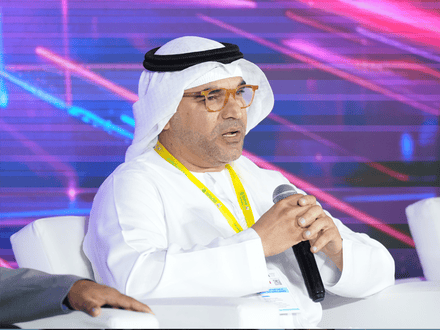
Inside the event
A glimpse of the atmosphere from previous editions — keynotes, the exhibition floor and the networking that defines World AI Technology Expo Dubai.





Key takeaways
- Sort everything you learn into durable fundamentals worth deep study and disposable specifics best learned just-in-time; the fundamentals let you understand new releases in an afternoon.
- Run a three-tier information diet: fast daily awareness, a few focused hours of depth per week, and the majority of your time spent building.
- Small, disposable projects build calibrated intuition about latency, cost and failure modes that no amount of reading can provide.
- You do not need to read every paper; follow trusted synthesisers, read primary sources strategically, and stay sceptical of results that have not survived a few months.
- Treat your network and learning in public as distributed sensing that saves you from evaluating everything yourself.
- Adopt new tools through a consistent rubric and let others absorb early instability for production systems, while being deliberately early on low-stakes experiments.
Frequently asked questions
Build a filtering system rather than consuming more. Spend a few minutes daily on broad awareness, a couple of focused hours weekly reading primary sources on things directly relevant to your work, and the bulk of your time building small projects. Deciding what to ignore is more important than trying to read everything.
A sustainable split for a working engineer is roughly fifteen minutes a day on awareness, one to two focused hours a week on depth, and as much hands-on building time as you can protect. Schedule it as a recurring block, because unscheduled learning is always crushed by delivery pressure.
No. Follow a small number of trusted synthesisers who read widely for you, and read original papers only when a result directly affects a decision you are making. When you do read one, start with the abstract, figures and limitations, and pay close attention to how results were evaluated.
Apply a consistent rubric: what specific problem does it solve that your current stack cannot, what is the full switching cost, how stable is the interface, and what happens if the project is abandoned. For production systems, let others absorb early instability; for low-stakes experiments, being early is how you learn fastest.
Build a small, disposable project that uses it on a real problem of your own. Personally experiencing the latency, cost and failure modes gives you calibrated intuition that reading cannot, and a short log of each experiment becomes a personal knowledge base more valuable than any bookmarks.