Most models do not fail loudly. They rot quietly. The API still returns a 200, the dashboard still renders a number, and the pipeline still runs green — while the predictions underneath drift steadily away from reality. This is precisely why AI model monitoring matters more than the training run that preceded it: a model is a perishable asset whose accuracy is a function of a world that refuses to stay still. Customer behaviour shifts, an upstream feature changes units, a foundation model provider silently updates a checkpoint, and the model you validated three months ago is now quietly wrong in ways nobody has been paged about.
The good news is that catching this degradation early is a tractable engineering problem, not a research one. You do not need a perfect ground-truth signal or an academic drift theory to protect a production system. You need a handful of well-chosen metrics, a baseline to compare against, thresholds that reflect real business tolerance, and a feedback loop that closes the gap between 'something looks off' and 'here is what changed'. This article walks through how to build that discipline: what drift actually is, which signals to instrument, how to detect change without drowning in false alarms, and how to turn monitoring into an early-warning system rather than a post-mortem tool.
Why models decay: drift is a property of the world, not a bug
Before you can monitor drift, it helps to be precise about what is drifting. A trained model encodes a fixed relationship between inputs and outputs, learned from a snapshot of data. Deployment freezes that relationship in time, but the environment generating the inputs keeps evolving. When the distribution of the inputs moves, you have data drift: the model is now being asked questions unlike those it trained on. When the relationship between inputs and the target moves — the same inputs now imply a different outcome — you have concept drift, which is more insidious because the input distribution can look perfectly stable while the model's assumptions quietly become false.
These changes arrive on very different timescales, and effective model drift detection has to account for all of them. Sudden drift is a step change: a pricing rule flips, a new market launches, an upstream service starts sending nulls. Gradual drift is a slow slope: user preferences evolve over a season, inflation shifts spending patterns. Recurring or seasonal drift cycles predictably — weekends, holidays, end-of-quarter behaviour — and will generate false alarms if you treat it as anomalous.
The practical consequence is that there is no single 'drift number' to watch. A model serving fraud decisions, a demand forecast, and a large language model powering a support assistant each fail in distinct ways. Naming the type of drift you actually fear for a given system tells you which signal to instrument and how fast you need to react to it.
The signals worth instrumenting in production model monitoring
Think of monitoring as concentric rings, from cheap-and-immediate to expensive-and-delayed. The outermost ring is operational telemetry you already collect for any service: latency, error rates, throughput, timeouts, and cost per request. These catch the crudest failures — a feature pipeline that stalls, a provider that starts rate-limiting — and cost you almost nothing to add. Never skip them in the rush to build clever statistical detectors.
The next ring is input monitoring: the distribution of every feature entering the model. Track per-feature summaries — mean, variance, quantiles, null rate, cardinality for categoricals, and the share of out-of-range or unseen values. This is the workhorse of data drift detection because it needs no labels and updates in real time. A feature that suddenly reads 40 per cent nulls, or a categorical that sprouts a new dominant value, is often the first fingerprint of an upstream change that will eventually corrupt predictions.
The third ring is output monitoring: the distribution of the model's own predictions and, for probabilistic models, their confidence or score distribution. A classifier whose positive rate jumps from 3 per cent to 12 per cent overnight is telling you something even if you have no ground truth yet. For generative systems, monitor response length, refusal rates, format-validity, and the rate at which downstream validators or guardrails reject outputs. The innermost, most valuable ring is true performance against labels — accuracy, precision, calibration, business KPIs — which is the ground truth but usually arrives late or partially. Mature ml model observability blends all four rings so that a cheap early signal can be corroborated by a slower, more authoritative one.
Choosing baselines and detection methods that do not cry wolf
Every drift metric is a comparison against a reference, so the choice of baseline is half the battle. A frozen baseline — the training or validation set — answers 'has the world moved away from what the model learned?' A rolling baseline — the trailing few weeks of production traffic — answers 'is today unusual relative to recent normal?' They detect different things, and serious systems keep both. The frozen baseline guards against long-term erosion; the rolling one catches sudden breaks without being tricked by slow, expected evolution.
For the detection itself, match the method to the data type. For continuous features, population stability index and distributional distances such as Kolmogorov–Smirnov or the Wasserstein distance quantify how far a live window has moved from the reference. For categoricals, compare frequency tables and watch for novel categories. For high-dimensional inputs like embeddings from a foundation model, univariate tests miss joint shifts, so monitor distances in the embedding space or train a lightweight 'drift classifier' that tries to distinguish reference from live data — if it succeeds well above chance, the distributions have separated.
The hard part is thresholds, and this is where most monitoring programmes drown. A p-value on a million requests will flag statistically significant drift that is practically meaningless, so anchor thresholds to effect size and business impact, not significance alone. Require persistence — drift sustained over several windows rather than a single spike — before paging a human. Use severity tiers: a quiet log for minor movement, a ticket for sustained moderate drift, a page only when a signal that correlates with real harm crosses a hard line. Tune against historical incidents so your alerts reflect problems you actually had, not textbook thresholds.

Past Speakers
Previous editions of World AI Technology Expo Dubai have brought together senior AI practitioners and leaders. Speakers below are shown for reference from previous editions; the 2027 line-up will be announced ahead of the event.

Nitin Akarte

Akshay Singh Dalal

James Hunter

Abhinav Sharma
When you cannot see the labels: proxies and delayed ground truth
The uncomfortable reality of production monitoring is that the metric you care about most — was the prediction correct? — is often unavailable at inference time and sometimes for weeks after. A loan-repayment model may not know it was wrong for months; a demand forecast is only judged once the period it predicted has passed; a recommendation is only validated when the user does or does not click. Building your entire safety net on delayed labels means learning about failures far too late.
The answer is a layered strategy. Lean on unsupervised signals — input and output drift — as your leading indicators, and treat delayed labels as confirmation that either validates or recalibrates those indicators. Where you can, engineer cheaper proxy labels: implicit feedback such as clicks, corrections, escalations, retries, or thumbs-down; heuristic checks; or a small, continuously sampled slice sent for human review. A steadily sampled human-labelled stream, even at one or two per cent of traffic, gives you a running estimate of true performance and a way to calibrate which drift signals genuinely predict harm.
For generative and agentic systems the label problem is sharper still, because 'correct' is fuzzy and expensive to judge. Here a common pattern is to use a separate model as an automated evaluator scoring samples of production traffic against a rubric, backstopped by periodic human audits to keep the evaluator honest. Combine that with hard structural checks you can compute for free — did the output parse, did the tool call have valid arguments, did a retrieval step return anything, did a guardrail fire — and you have a usable quality signal long before any human verdict arrives.
Monitoring foundation models, RAG and agents
Systems built on large language models break the classical monitoring picture because you often do not own the model, the inputs are unstructured text, and the same prompt can yield different outputs run to run. You cannot watch a neat feature vector, and a provider can update a hosted model beneath you without notice, shifting behaviour in ways no drift test on your side predicted. Treat the model version and configuration as first-class monitored metadata, and re-run a fixed regression suite of representative prompts on a schedule so a silent upstream change surfaces as a measurable diff.
For retrieval-augmented systems, most failures live in the retrieval layer, not the model. Monitor retrieval quality directly: hit rate, the relevance scores of returned chunks, the fraction of answers with no supporting context, and drift in the query distribution as users ask about things your index does not cover. A corpus that grows stale is a form of data drift specific to these systems — the world moved, your index did not — and it degrades answers even though the model itself is unchanged.
Agentic systems add trajectory-level signals: steps per task, tool-call success and error rates, loop or retry frequency, escalation rates, and end-to-end task completion. A rising average step count or a climbing tool-error rate is often the earliest sign that an upstream API contract changed or that inputs have drifted outside what your prompts and tools handle gracefully. Because these pipelines chain many components, invest early in tracing so that when a top-line metric moves you can attribute it to the specific stage — retrieval, planning, a particular tool — that caused it. Practitioners wrestling with exactly these patterns can compare notes with peers, vendors and investors and go deeper at World AI Technology Expo Dubai (07-09 April 2027, Millennium Plaza Downtown Hotel, Dubai).
Closing the loop: from alert to action
A drift alert is worthless if nobody knows what to do with it, so decide the response before the incident, not during it. For each monitored system, write down the runbook: what each alert means, how to confirm it is real, who owns triage, and which remediations are on the table. Detection without a defined response just trains your team to ignore a noisy dashboard.
Remediation is a ladder, and you should climb only as far as the problem demands. The cheapest rung is investigation: is this a genuine model problem or a broken upstream feed? A shocking share of 'model drift' is really a data pipeline bug — a unit change, a schema migration, a null-handling regression — and reverting the pipeline fixes it instantly. The next rung is mitigation without retraining: adjust a decision threshold, route uncertain cases to human review, temporarily fall back to a simpler and more robust model, or narrow the system's scope. Retraining is the expensive rung, justified when the world has genuinely shifted, and it demands fresh, correctly labelled data that reflects the new reality rather than a mechanical re-run on stale examples.
Guard against automating yourself into a corner. Fully automatic retraining triggered by a drift alert can amplify a data bug into a worse model faster than any human could — the classic feedback loop where a model's own outputs pollute the data it later trains on. Keep a human in the approval path for anything that changes what production serves, and always retain the ability to roll back to a known-good version quickly. Fast, reliable rollback is often a better investment than a cleverer detector.
Building a monitoring practice that lasts
Tooling matters less than the operating discipline around it. The teams who catch drift early are not the ones with the most exotic statistics; they are the ones who treat monitoring as a product with an owner, a budget, and a review cadence rather than a dashboard someone built once and forgot. Assign clear ownership for each model's health, and put drift and performance trends on a recurring review so that slow degradation gets noticed by humans, not just thresholds.
Standardise the plumbing so every new model inherits monitoring by default. A shared layer that logs inputs, outputs, model version and outcomes in a consistent schema — often flowing through the same experiment-tracking and observability tooling your team already uses — means the marginal cost of monitoring the next model approaches zero. When instrumentation is opt-in and bespoke, it quietly gets skipped under deadline pressure, and the unmonitored model is always the one that fails.
Finally, treat every incident as a chance to sharpen the system. When a model degrades, ask which signal should have caught it earlier and whether your thresholds were too slack or too noisy, then feed that back into the detectors. Over time this turns monitoring from a static safety net into a compounding asset — a body of hard-won knowledge about how your specific models fail — which is ultimately what separates a resilient production AI system from one that is merely lucky.
Inside the event
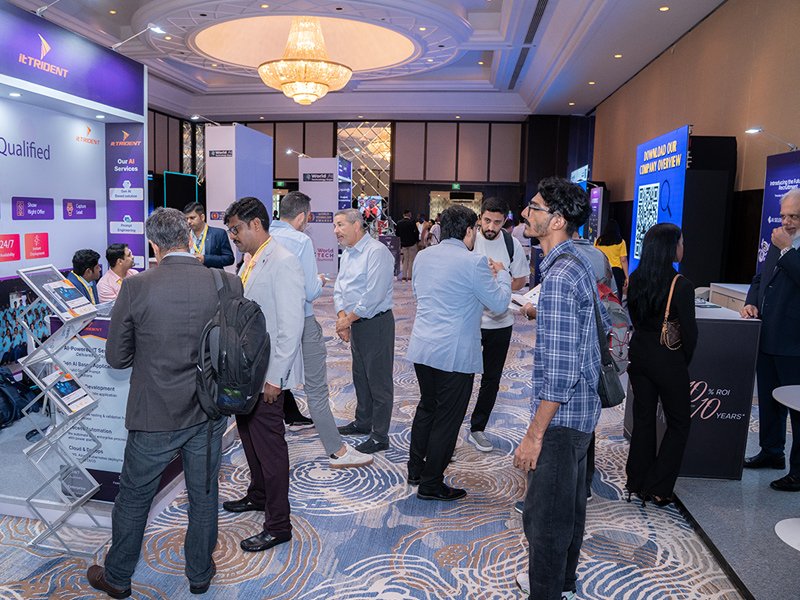
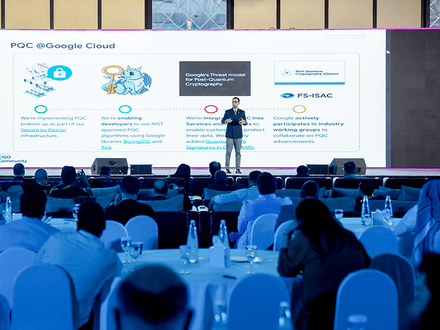
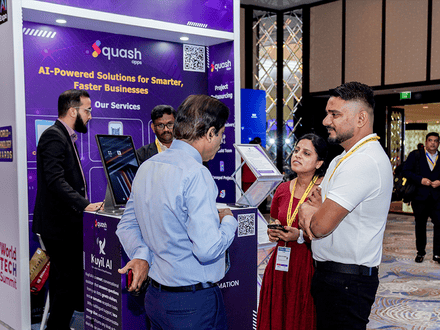
A glimpse of the atmosphere from previous editions — keynotes, the exhibition floor and the networking that defines World AI Technology Expo Dubai.




Key takeaways
- Models decay because the world changes, not because of a bug; monitor for data drift (inputs move) and concept drift (input-to-output relationship moves) separately, because they fail on different timescales.
- Instrument in concentric rings — operational telemetry, input distributions, output distributions, and true labels — so cheap real-time signals can be corroborated by slower, more authoritative ones.
- Keep both a frozen training baseline and a rolling recent-traffic baseline; anchor alert thresholds to business impact and require persistence over multiple windows to avoid drowning in false alarms.
- When ground-truth labels arrive late or never, lean on unsupervised drift signals and engineered proxies (clicks, escalations, automated evaluators, sampled human review) as leading indicators.
- Foundation-model, RAG and agentic systems need specialised signals: pinned model versions, retrieval hit rate and relevance, tool-call success, and task-completion metrics backed by tracing.
- Define the runbook before the incident, climb the remediation ladder from investigation to threshold tweaks to retraining, and always keep a human in the loop with fast rollback to a known-good version.
Frequently asked questions
Data drift is when the distribution of the model's inputs changes — it is being asked questions unlike those it trained on — while concept drift is when the relationship between inputs and the target outcome changes, so the same inputs now imply a different answer. Data drift is detectable without labels by watching input distributions; concept drift can occur with a stable input distribution and usually requires outcome data or proxies to detect. Most production systems need to watch for both.
Rely on unsupervised signals as leading indicators: track input feature distributions, prediction distributions, and operational metrics that need no labels. Engineer cheap proxy labels from implicit feedback such as clicks, corrections, retries or escalations, and continuously sample a small slice of traffic for human review to estimate true performance. Treat delayed labels, when they arrive, as confirmation that recalibrates which drift signals actually predict harm.
Retrain based on evidence of degradation, not a fixed calendar. First confirm the drift is a genuine model problem rather than an upstream data bug, then try cheaper mitigations like adjusting decision thresholds or routing uncertain cases to review. Retrain only when the world has genuinely shifted and you have fresh, correctly labelled data reflecting the new reality, and keep a human in the approval path so a data bug does not trigger an automatic bad retrain.
Pin and monitor the model version and configuration, since a hosted model can change beneath you. For the model, track response length, refusal and format-validity rates, and how often guardrails or downstream validators reject outputs. For retrieval, monitor hit rate, chunk relevance scores, and the share of answers lacking supporting context; for agents, watch steps per task, tool-call error rates and task completion, all backed by tracing so you can attribute a regression to a specific stage.
Monitoring tells you that something is wrong by watching predefined metrics against thresholds; ml model observability gives you the instrumentation to understand why, by capturing inputs, outputs, model versions, features and traces in a consistent, queryable form. Observability lets you drill from a top-line alert down to the specific feature, retrieval step or tool that caused the change. In practice you want both: monitoring for detection, observability for diagnosis.