
Getting a machine learning model to production is where most of the real engineering happens, and it is also where most projects quietly stall. A model that scores well in a notebook has cleared only the first hurdle: it works once, on data you curated, on your laptop, with you watching. Production demands something categorically harder. The same model must return predictions under latency budgets, survive messy real-world inputs, be reproducible six months later, degrade gracefully when upstream data shifts, and be observable enough that you know it is failing before your users do. The gap between a promising prototype and a dependable service is not a modelling problem at all. It is a systems problem.
This guide walks through that transition end to end, aimed at ML and data practitioners, engineering leaders and founders who have a working model and now need to make it earn its keep. We will cover how to harden a prototype, package and serve it, choose an ml model deployment pattern, validate before release, monitor once live, and build the feedback loops that keep it healthy. The emphasis throughout is on trade-offs and concrete decisions rather than tooling for its own sake, because productionising machine learning is ultimately about matching engineering effort to the risk and value of the use case.
Define production before you write a line of deployment code
"Production" is not a single destination, and one of the most expensive mistakes teams make is over-engineering for a bar they will never need or under-engineering for one they cannot see coming. Before touching infrastructure, write down the operating envelope in plain terms: what latency the prediction must meet, how many requests per second at peak, how fresh the input features need to be, and what happens if the model is unavailable or returns nonsense. A model behind an internal batch report and a model in the synchronous path of a checkout flow are different engineering problems that happen to share a training script.
Pin down the interface next. What exactly goes in, what comes out, and in what units or schema? Decide whether predictions are consumed online (one request at a time, low latency), in near-real-time streams, or in scheduled batches, because that single choice cascades into everything downstream. A recommendation refresh that runs nightly can be a scheduled job writing to a table; a fraud score needed in under fifty milliseconds cannot.
Finally, agree on what success and failure look like in business terms, not just model metrics. A two-point gain in offline accuracy is meaningless if it does not move the metric the model exists to serve. Tie the model to a decision, attach a monitorable outcome to that decision, and you will have a north star that keeps deployment scope honest.
Harden the prototype into reproducible, testable code
Notebook code is written to be read once and discarded; production code is written to be run thousands of times unattended. The first concrete step is to lift the logic out of the notebook into modular, version-controlled code with a clear separation between data preparation, feature transformation, training and inference. The feature transformations in particular must be shared between training and serving, because a subtle difference between how a feature is computed offline and online, known as training-serving skew, is one of the most common and hardest-to-diagnose failures in ml in production.
Reproducibility is non-negotiable. Every model artefact should be traceable to the exact code, data snapshot, hyperparameters and library versions that produced it. In practice this means pinning dependencies, versioning your datasets or at least recording immutable references to them, setting random seeds where it matters, and logging each run to an experiment-tracking tool so you can answer "what produced this model?" months later. Treat the trained model as a build artefact with provenance, not a file someone emailed around.
Add tests that a stakeholder would actually trust. Unit-test the transformation functions, add a data-validation step that rejects inputs violating expected schemas or ranges, and write behavioural checks that assert the model responds sensibly to known cases and obvious edge cases. A prediction pipeline that silently accepts a null where it expected a number, or a category it has never seen, will fail in production in ways your offline metrics never revealed.
Package the model and choose a serving pattern
Once the code is trustworthy, package it so it runs the same way everywhere. Containerisation is the pragmatic default: bundle the model, its runtime and its dependencies into an image that behaves identically on a laptop, in CI and in the cluster. Keep the model weights separate from the application image where you can, so you can promote a new model version without rebuilding and redeploying the whole service.
Model serving then splits into a few well-worn patterns, and the right one follows directly from the operating envelope you defined earlier. Online serving exposes the model behind an API for synchronous, low-latency requests. Batch serving runs predictions on a schedule over large volumes and writes results to a store the application reads from. Streaming serving sits in between, scoring events as they flow through a pipeline. Many mature systems run more than one pattern for the same model, for example a nightly batch to pre-compute the common cases and an online endpoint for the long tail.
Resist reaching for the heaviest option by default. A single containerised service behind a load balancer handles a surprising amount of traffic and is far easier to reason about than a bespoke distributed setup. Introduce a dedicated model-serving runtime, autoscaling or hardware accelerators when a measured bottleneck justifies them, not before. For large foundation models the calculus shifts, since GPU memory, batching and cold-start times dominate, but the discipline is identical: measure the real constraint, then spend engineering effort against it.

Past Speakers
Previous editions of World AI Technology Expo Dubai have brought together senior AI practitioners and leaders. Speakers below are shown for reference from previous editions; the 2027 line-up will be announced ahead of the event.

Nitin Akarte

Akshay Singh Dalal

James Hunter

Abhinav Sharma
Validate the model against production reality, not the test set
An offline test set tells you how the model performs on data that looks like the past. Production will hand it data that looks like the present, which is subtly and sometimes dramatically different. Before release, evaluate the model on the freshest data you can get, and slice performance across the segments that matter, because an aggregate score can hide serious weaknesses in a subpopulation that happens to be commercially important or sensitive.
Where a wrong answer carries real consequences for people, treat validation as a fairness and robustness exercise, not just an accuracy one. Check performance parity across relevant groups, probe how the model behaves on adversarial or out-of-distribution inputs, and document the limitations honestly. None of this is legal advice, but a written record of what the model was tested on and where it should not be trusted is the difference between a defensible system and a liability waiting to surface.
Wrap this into a release gate. A model should not reach users unless it passes a defined evaluation threshold on current data, clears the behavioural tests, and its predictions have been sanity-checked by someone with domain context. Automating this gate as part of your deployment pipeline turns model quality from a subjective judgement into a repeatable check that anyone on the team can run and trust.
Roll out deliberately with staged deployment
Never flip an untested model into full production traffic in a single step. Staged rollout strategies exist precisely because offline validation cannot catch everything. A shadow deployment runs the new model alongside the current one, receiving real traffic but with its predictions logged rather than served, letting you compare behaviour on live data with zero user risk. Only once shadow results look sound do you start serving real predictions.
From there, a canary or gradual rollout exposes the new model to a small slice of traffic, watches the operational and quality signals, and expands only if they hold. Where the goal is to prove that the model improves a business outcome rather than just a technical metric, an online experiment that randomly assigns users between the old and new versions gives you a causal read on impact. Keep the previous version warm and make rollback a single, well-rehearsed action, because the fastest way to contain a bad release is to undo it instantly rather than debug it live.
This staged discipline is also where teams building serious systems compare notes; the practitioners solving ml model deployment at scale, along with the vendors and investors backing them, are exactly the crowd you will find swapping hard-won rollout lessons at events like World AI Technology Expo Dubai (07-09 April 2027, Millennium Plaza Downtown Hotel, Dubai). The patterns are simple to state and genuinely hard to operationalise, which is why they reward comparing approaches with peers who have been burned.
Monitor everything, because models rot quietly
Software either works or throws an error; a model can be confidently, silently wrong. That asymmetry is why monitoring is the heart of running ml in production rather than an afterthought. Instrument three layers. First, operational health: latency, throughput, error rates and resource usage, the same signals any service needs. Second, data health: monitor the distribution of incoming features and flag drift when live inputs diverge from what the model was trained on. Third, prediction health: track the distribution of outputs and, wherever ground truth eventually arrives, the model's realised accuracy over time.
The hardest part is that ground truth is often delayed or partial. A model predicting whether a customer will churn will not be proven right or wrong for weeks. In the meantime, proxy signals such as sharp shifts in input distributions, sudden changes in the mix of predicted classes, or rising rates of low-confidence outputs act as early warnings that something upstream has changed. Set alert thresholds that a human will actually respond to, and route them to a named owner rather than a dashboard nobody watches.
Close the loop by capturing predictions and, when it lands, the corresponding outcome, into a store you can query and learn from. This log is simultaneously your debugging trail, your retraining dataset and your audit record. A team that cannot reconstruct why a specific prediction was made on a specific day is flying blind, and rebuilding that capability after an incident is far more painful than instrumenting it upfront.
Build the retraining and feedback loop that keeps it alive
Deployment is the beginning of the model's operational life, not the end of the project. The world the model describes keeps moving, and performance decays as reality drifts away from the training distribution. Decide upfront how the model will be refreshed: on a fixed schedule, when monitoring signals cross a drift or performance threshold, or when enough new labelled data has accumulated to justify it. Each approach trades simplicity against responsiveness, and the right choice depends on how fast your domain actually changes.
Whatever the trigger, the retraining path should reuse the exact same pipeline, validation gate and staged rollout as the original release. This is the payoff for the discipline established earlier: a new model version becomes a routine, low-drama promotion rather than a fresh integration effort. The mature end state of productionising machine learning is a system where retraining, evaluation and deployment are automated and observable, and human judgement is reserved for the decisions that genuinely need it.
Guard against automation's failure modes too. A feedback loop that retrains on the model's own influenced outcomes can quietly reinforce its biases, and an automated pipeline that promotes a subtly broken model is more dangerous than a manual one that a human would have questioned. Keep a human checkpoint at the release gate for higher-stakes models, and periodically audit the loop itself, not just the model it produces.
Inside the event
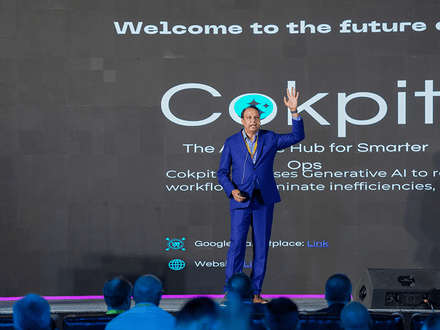
A glimpse of the atmosphere from previous editions — keynotes, the exhibition floor and the networking that defines World AI Technology Expo Dubai.





Key takeaways
- Define the operating envelope, interface and business outcome before choosing any deployment infrastructure; production scope should follow risk and value, not fashion.
- Reproducibility and shared training-serving feature logic are foundational; training-serving skew is a top cause of silent failure in ml in production.
- Match the serving pattern (online, batch or streaming) to real latency and volume constraints, and prefer the simplest option that measurably works.
- Validate on fresh, sliced data behind an automated release gate, then roll out via shadow, canary and rollback rather than a single switch.
- Monitor operational health, data drift and prediction quality together, and log every prediction plus eventual outcome for debugging, retraining and audit.
- Treat deployment as the start of an operational loop: plan retraining triggers upfront and reuse the same pipeline and gate for every model version.
Frequently asked questions
The hardest part is rarely the modelling; it is the surrounding systems work. Reproducibility, avoiding training-serving skew, handling messy real-world inputs, and monitoring a model that can be silently wrong are what separate a prototype from a dependable service. Most stalled projects fail on engineering and observability, not on model accuracy.
Let the use case decide. Choose online serving when predictions are needed synchronously under tight latency, such as in a live request path. Choose batch when predictions can be pre-computed on a schedule and read from a store, and streaming when you need to score events continuously as they arrive. Many systems combine batch pre-computation with an online endpoint for the long tail.
There is no universal answer; it depends on how fast your data distribution changes. Options include fixed schedules, triggering retraining when monitoring detects drift or a performance drop, or retraining once enough new labelled data accumulates. Drift-triggered retraining is often the most efficient, provided you have reliable monitoring to trigger it.
Monitor three layers: operational health such as latency, throughput and error rates; data health, meaning drift between live input distributions and training data; and prediction health, tracking output distributions and realised accuracy as ground truth arrives. Because true labels are often delayed, use proxy signals like input drift and confidence shifts as early warnings, routed to a named owner.
Not to start. A single containerised service behind a load balancer, with versioned artefacts, a validation gate and basic monitoring, covers a large share of use cases. Introduce dedicated serving runtimes, autoscaling or accelerators only when a measured bottleneck justifies the added complexity.