Understanding how large language models work has become table stakes for anyone building software in 2026. Whether you are a data scientist tuning a retrieval pipeline, an engineering leader budgeting for inference, or a founder deciding what to build, you cannot make good architectural decisions while treating the model as a black box that magically returns text. The good news is that the core machinery is more approachable than the hype suggests. At their heart, these systems are large neural networks trained to predict the next unit of text given everything that came before, and almost every capability and limitation you encounter in production flows from that single, deceptively simple objective.
This explainer walks through the actual mechanics without drowning you in linear algebra: how text becomes numbers, why transformer models changed everything, what happens during training versus inference, and how the abstract idea of foundation models translates into the systems you ship. Along the way we will keep the focus on engineering and business reasoning, the trade-offs that bite in real deployments, and the mental models that help you debug strange behaviour. Think of this as the LLM explained for people who need to build with it, not just talk about it.
From text to tokens: the input the model actually sees
A language model never sees words the way you do. The first step in any pipeline is tokenisation, which breaks raw text into subword units called tokens. A token is often a whole common word, but longer or rarer words fragment into pieces, and punctuation and whitespace carry their own tokens. As a rough rule of thumb for English, one token is about four characters or three-quarters of a word, which is why a 1,000-word document lands somewhere near 1,300 to 1,500 tokens.
This matters far more than it first appears, because tokens are the unit of billing, the unit of the context window, and the unit of latency. When you estimate the cost of a feature, you are really counting input plus output tokens. When you hit a context limit, you are hitting a token ceiling, not a word count. Subword tokenisation also explains some odd failures: models can struggle with character-level tasks like counting letters or reversing strings precisely because they perceive chunks, not individual characters.
Each token is mapped to a vector of numbers called an embedding, a learned representation that places semantically related tokens near one another in a high-dimensional space. Before any reasoning happens, your prompt is simply a sequence of these vectors. Everything the model does downstream is arithmetic over those numbers, which is worth remembering whenever a result feels mysteriously non-deterministic or sensitive to phrasing.
Transformer models: attention is the engine
The breakthrough that made modern large language models possible is the transformer architecture, and its central mechanism is self-attention. For every token in the sequence, attention lets the model weigh how much each other token should influence its representation. In a sentence like 'the engineer opened the ticket because it was blocking release', attention is what lets the model connect 'it' to 'the ticket' rather than 'the engineer'. Crucially, this happens for all positions in parallel, which is why transformers train efficiently on modern accelerators compared with the sequential recurrent networks that preceded them.
A transformer stacks dozens of layers, each containing attention plus a feed-forward network, and each layer refines the representation of every token using context from the whole sequence. Early layers tend to capture surface patterns like syntax, while deeper layers encode more abstract relationships. The model's 'knowledge' lives in the billions of weights across these layers, adjusted during training so that useful patterns become baked into the arithmetic.
You do not need to implement attention to benefit from understanding it. It explains why context quality matters so much: the model can only attend to what you put in the window, so a well-structured prompt with the relevant facts nearby often beats a longer, noisier one. It also explains a practical cost curve, because naive attention scales quadratically with sequence length, which is why very long contexts are expensive and why techniques to compress, cache or retrieve context are an active engineering concern.
Training: how foundation models learn
The training of foundation models happens in stages, and conflating them causes a lot of confusion. The first and most expensive stage is pre-training, where the model reads an enormous corpus of text and learns a single objective: predict the next token. Repeated across trillions of tokens, this forces the network to internalise grammar, facts, reasoning patterns, code structure and more, purely as a side effect of getting better at prediction. This stage produces the raw base model and is what makes it a 'foundation' that many downstream uses can build on.
A raw base model is knowledgeable but unwieldy, so a second stage aligns it to be useful and follow instructions. This typically combines supervised fine-tuning on curated examples of good responses with a preference-optimisation step where the model learns from human or automated judgements about which of two answers is better. This is where a model learns to answer a question directly rather than, say, continue it with more questions. Understanding this split clarifies why a model can be simultaneously brilliant and brittle: its knowledge comes from pre-training, but its helpfulness and refusals come from a much smaller, more deliberate alignment phase.
For most teams, training a model from scratch is neither necessary nor economical. The practical spectrum runs from prompting a general model, to lightweight adaptation such as parameter-efficient fine-tuning that adjusts a small set of extra weights, to full fine-tuning for narrow high-volume tasks. A sensible default is to exhaust prompting and retrieval first, measure where they fall short, and only then invest in fine-tuning, because fine-tuning adds a data pipeline, an evaluation burden and a retraining cost every time the world changes.

Past Speakers
Previous editions of World AI Technology Expo Dubai have brought together senior AI practitioners and leaders. Speakers below are shown for reference from previous editions; the 2027 line-up will be announced ahead of the event.

Nitin Akarte

Akshay Singh Dalal

James Hunter

Abhinav Sharma
Inference: what happens when you hit send
At inference time the model generates one token at a time. Given your prompt, it produces a probability distribution over the entire vocabulary for the next token, samples one according to that distribution, appends it to the sequence, and repeats. This autoregressive loop is why output streams in gradually and why longer responses cost proportionally more and take longer. It also explains a subtle failure mode: an early wrong token can send the whole continuation down a bad path, since each step conditions on everything generated so far.
You have direct control over this sampling through a few parameters. Temperature scales how sharply the model favours its top choices; low values make output focused and repeatable, higher values make it more varied and creative. Related controls limit sampling to the most probable tokens. For extraction, classification or code, keep temperature low for consistency. For brainstorming or copy, raise it. Setting a fixed random seed where available improves reproducibility, but note that distributed inference and hardware differences mean bit-for-bit determinism is rarely guaranteed.
This generative process is also the source of hallucination. The model optimises for plausible next tokens, not for truth, so when it lacks grounding it will confidently produce fluent, well-formed text that is simply wrong. That is not a bug you can prompt away entirely; it is a property of the objective. The engineering response is to supply authoritative context, constrain outputs, and verify claims rather than to expect the raw model to know when it does not know.
Context windows, retrieval and grounding
Everything the model 'knows' in a given call is either baked into its weights from training or supplied in the context window for that request. The weights are frozen and have a knowledge cut-off, so anything recent, private or organisation-specific must arrive through the prompt. This is the whole rationale behind retrieval-augmented generation: fetch the relevant documents at query time and place them in context so the model can ground its answer in real data rather than parametric memory.
A typical retrieval setup embeds your documents into vectors, stores them in a vector database, and at query time embeds the user's question, finds the nearest chunks and injects them into the prompt. Done well, this dramatically reduces hallucination on factual questions, keeps answers current without retraining, and lets you cite sources. Done badly, it fails in predictable ways: chunks too large to be precise or too small to be coherent, embeddings that miss the semantic match, or so much retrieved text that the genuinely relevant passage gets lost among distractors.
Larger context windows have eased some of these constraints, but they do not eliminate the discipline. Stuffing a huge window with loosely relevant material raises cost and latency and can dilute attention on what matters. The pragmatic pattern in 2026 is retrieval plus a right-sized window: pull the best evidence, order it thoughtfully, and treat the context budget as a scarce resource you curate rather than a bucket you fill. Practitioners refining these grounding pipelines are exactly the crowd swapping hard-won lessons at events such as the World AI Technology Expo Dubai (07-09 April 2027, Millennium Plaza Downtown Hotel, Dubai), where peers, vendors and investors gather to compare notes.
From single calls to systems: agents and tools
A single prompt-and-response is only the atom of a real application. Because a model can generate structured output, you can have it emit a function call, run that function in your own code, and feed the result back in for the next step. This tool-use loop is what lets a model query a database, call an internal service, run a calculation or search a knowledge base rather than guessing. It turns a text predictor into something that can take actions against real systems under your supervision.
Chaining these steps yields what people now call agents: a model that plans, calls tools, observes results and iterates towards a goal, often orchestrated by an agent framework. The appeal is obvious, but so are the failure modes. Each additional step compounds latency and cost, errors can cascade when one bad tool call poisons the next, and open-ended loops can wander. The engineering craft lies in bounding the loop, validating tool outputs, and designing for graceful failure rather than assuming the model will always recover.
A useful discipline is to start with the least autonomy that solves the problem. Many tasks marketed as needing full agents are handled better by a fixed pipeline with one or two well-placed model calls and deterministic code around them. Reserve open-ended agentic loops for genuinely open-ended problems, and instrument everything so you can see which step failed when the overall result is wrong.
Evaluation, cost and the trade-offs that decide production
The gap between a convincing demo and a dependable product is evaluation. Because outputs are probabilistic and open-ended, you cannot rely on a handful of manual spot-checks. Build a representative test set of real inputs with known-good expectations, and score against it whenever you change a prompt, a model or a retrieval setting. Combine automated checks such as exact matches, structural validation and reference comparisons with targeted human review for the judgement-heavy cases, and track results over time in an experiment-tracking tool so you can prove a change helped rather than hoping it did.
Cost and latency are first-class design constraints, not afterthoughts. Larger models are more capable but slower and pricier per token, so a common pattern is to route easy requests to a smaller, cheaper model and reserve a larger one for hard cases, or to cache responses and retrieved context aggressively. Streaming output improves perceived latency even when total time is unchanged, and trimming prompts pays back on every single call. These are the levers that turn an interesting prototype into an economically viable feature.
Finally, treat reliability as a system property rather than a model property. Constrain outputs to schemas your code can parse, validate before you act on anything, add guardrails for inputs and outputs, and keep a human in the loop where the cost of a mistake is high. The generative AI basics are learnable in an afternoon, but production maturity comes from the surrounding scaffolding: good evaluation, sensible fallbacks, observability and a clear-eyed view of what the model can and cannot be trusted to do.
Inside the event
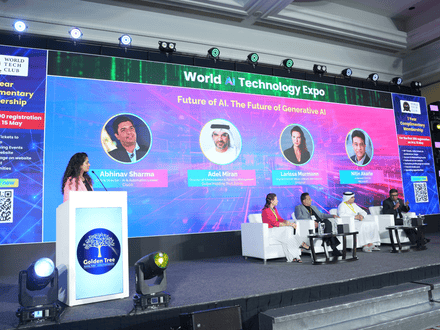
A glimpse of the atmosphere from previous editions — keynotes, the exhibition floor and the networking that defines World AI Technology Expo Dubai.





Key takeaways
- Large language models are next-token predictors: nearly every capability and limitation, including hallucination, follows from that single training objective.
- Tokens are the unit of cost, context and latency, so estimating and controlling token usage is a core engineering task, not a detail.
- The transformer's attention mechanism is why context quality matters so much and why very long contexts are expensive.
- Training splits into pre-training for knowledge and alignment for helpfulness; exhaust prompting and retrieval before investing in fine-tuning.
- Grounding through retrieval and a curated context window is the most reliable lever against out-of-date or hallucinated answers.
- Production reliability comes from the scaffolding around the model: rigorous evaluation, output validation, cost routing and human oversight.
Frequently asked questions
A large language model converts text into tokens, processes them through many layers of a transformer neural network, and predicts the most likely next token one step at a time. Repeating this loop produces fluent text. All of its apparent reasoning is learned statistical pattern-matching over the enormous corpus it was trained on, not explicit rules or a lookup of stored facts.
A foundation model is a large model pre-trained on broad data that can be adapted to many downstream tasks, and large language models are the text-based instance of that idea. In practice the terms overlap heavily, but 'foundation model' emphasises the general-purpose base you build on, while 'large language model' emphasises the language-generation capability itself.
They hallucinate because the objective rewards plausible next tokens, not verified truth, so with no grounding a model produces fluent but sometimes false statements. You cannot eliminate this entirely through prompting alone. The effective mitigations are supplying authoritative context through retrieval, constraining outputs, and verifying important claims with deterministic checks or human review.
For most teams, prompting combined with retrieval solves the problem without the cost and maintenance of fine-tuning. Start there, measure where quality falls short, and only fine-tune for narrow, high-volume tasks where prompting cannot reach the required consistency. Fine-tuning adds a data pipeline, an evaluation burden and a retraining cost each time your requirements change.
Cost is driven mainly by tokens, counting both the input you send and the output the model generates, multiplied by the per-token price of the model you choose. Larger models cost more per token and add latency. Teams control spend by right-sizing models, routing easy requests to cheaper ones, trimming prompts, and caching responses and retrieved context.